
What exercises help rebuild strength safely after injury?
Rebuilding strength after a sports injury is a delicate balance between challenging the muscles and protecting the healing tissues. In the UK, the clinical standard for rehabilitation follows a tiered approach known as progressive loading. This method ensures that the intensity of the exercise never exceeds the structural integrity of the healing bone or ligament. Whether you are recovering from a fracture, a surgery, or a severe sprain, the goal is to move from static muscle engagement to dynamic, real-world movements. Following this structured path helps prevent the cycle of re-injury and ensures that the muscles return to their pre-injury power and endurance.
What We’ll Discuss in This Article
- Phase 1: Isometric exercises for the early recovery stage
- Phase 2: Concentric and eccentric movements for muscle growth
- Phase 3: Compound and functional exercises for joint stability
- The importance of the “Proprioception” and balance training
- How to use the “Pain-Monitoring Model” to gauge intensity
- Standard UK physiotherapy tools for home rehabilitation
Phase 1: Isometric Exercises (Static Holds)
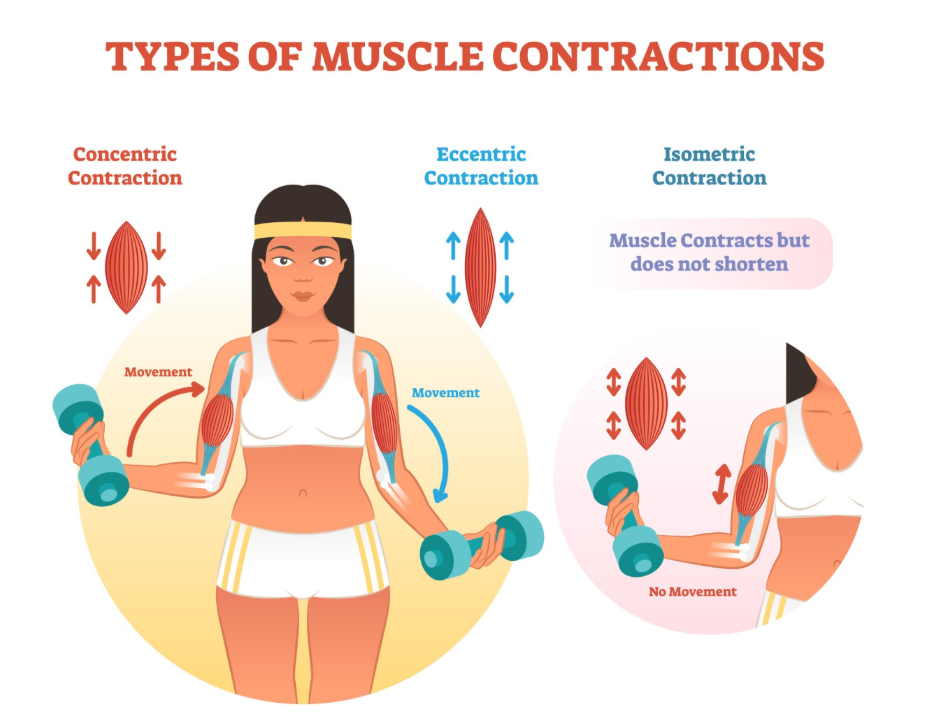
Isometric exercises are the safest way to begin rebuilding strength because they involve contracting the muscle without moving the joint. This is ideal when the joint is still fragile or immobilised in a cast.
- The Technique: You simply squeeze the target muscle and hold the tension for 5 to 10 seconds.
- Why it Works: It maintains the neural connection between the brain and the muscle, which prevents the severe “muscle wasting” that occurs during total rest.
- Example: Squeezing your thigh muscle (quadriceps) while your leg is straight, or gently pushing your wrist against a wall without moving the joint.
Phase 2: Controlled Range of Motion (Concentric and Eccentric)
Once a clinician confirms the tissue can handle movement, you move to “isotonic” exercises. These are the traditional movements where the muscle shortens and lengthens.
- Concentric: The muscle shortening under tension (e.g., the “up” part of a bicep curl).
- Eccentric: The muscle lengthening under tension (e.g., the “down” part of a bicep curl).
In the UK, physiotherapists often emphasise the eccentric phase, as this is highly effective at strengthening tendons and rebuilding muscle fibres after a tear.
Shutterstock
Phase 3: Progressive Loading and Resistance
As your range of motion returns to normal, you must add external resistance to continue the strengthening process. In the UK, this is typically done using resistance bands or light weights.
- Resistance Bands: These provide “variable resistance,” meaning the exercise gets harder as the band stretches, which is very safe for healing joints.
- Repetition Ranges: According to NICE clinical knowledge summaries, the initial focus should be on “muscular endurance” (lower weight, higher repetitions) before moving to “power” (higher weight, lower repetitions).
Restoring Balance and Proprioception
Strength is useless if the brain cannot coordinate the movement. Proprioception is your body’s ability to sense its position in space. Injury often disrupts the tiny sensors in the ligaments and joints.
- Single-Leg Stand: Balancing on the injured leg while performing a task like throwing a ball or brushing your teeth.
- Wobble Boards: Using unstable surfaces to force the small stabiliser muscles to react quickly. This is essential for preventing future sprains.
The Pain-Monitoring Model
A key part of safe strengthening is knowing when to stop. UK sports scientists use a simple “0 to 10” scale to guide patients:
- 0 to 2 (Safe): Minimal discomfort that disappears quickly after the session.
- 3 to 5 (Caution): Manageable ache that should return to baseline within 24 hours.
- 6 to 10 (Stop): Sharp or throbbing pain that suggests the tissue is being overloaded.
If your pain increases the morning after a session, it is a clear sign that the intensity of your exercises was too high.
Typical Strengthening Progression
| Stage | Exercise Type | Goal |
| Weeks 1-4 | Isometrics | Prevent muscle atrophy |
| Weeks 4-8 | Active Range of Motion | Restore joint flexibility |
| Weeks 8-12 | Resisted Exercises | Rebuild muscle volume |
| Months 3+ | Functional/Plyometric | Return to sports-specific power |
Conclusion
Rebuilding strength after an injury is a journey from simple muscle squeezes to complex, high-speed movements. By respecting the phases of healing and using the pain-monitoring model, you can safely guide your body back to full performance. The secret to a successful recovery is consistency; performing your prescribed “home exercise program” every day is far more effective than a single intense session once a week. If you experience severe, sudden, or worsening symptoms, call 999 immediately.
Can I use heavy weights if I don’t feel any pain?
Even if you feel strong, the internal tissue (like the bone callus or a ligament graft) may not be ready for heavy loads. Always follow the specific timelines provided by your orthopaedic specialist.
Why does the injured limb look so much smaller?
This is called “atrophy.” When a muscle isn’t used, the body stops sending resources to it. It is a normal part of injury, and with consistent training, the size will return.
Is swimming good for rebuilding strength?
Swimming is excellent for cardiovascular fitness and joint mobility, but it doesn’t provide the “loading” needed to strengthen bones. You must eventually transition to ground-based exercises.
How many days a week should I do my rehab?
In the early stages, “little and often” is best, perhaps 10 minutes three times a day. As the exercises get heavier, you may move to 3 or 4 longer sessions per week to allow for muscle recovery.
Can I use a “blood flow restriction” (BFR) cuff?
BFR is a specialised technique sometimes used in UK clinics to build muscle with very light weights. It should only be done under the direct supervision of a qualified physiotherapist.
What if my “good” leg is getting tired too?
It is common to overcompensate using the healthy side. Part of your rehab involves “unilateral” (single-sided) exercises to ensure the injured limb is doing its fair share of the work.
Does stretching count as strengthening?
No. While stretching is important for flexibility, it does not build the muscle tissue or bone density needed for a safe return to sport.
Authority Snapshot (E-E-A-T Block)
The purpose of this article is to provide the general public with a safe and evidence-based framework for musculoskeletal recovery. The content has been produced by the MyPatientAdvice team and reviewed by Dr. Petrov, a UK-trained physician with experience in sports medicine and rehabilitation. All exercise protocols are strictly aligned with the current standards of the NHS and NICE.
