




While both eczema and psoriasis are primarily recognised as skin conditions, their impact can extend beyond the surface of the skin. Psoriasis, in particular, is a systemic inflammatory condition that is well known for its ability to affect the nails and the joints. Eczema, while mostly confined to the skin, is often part of a broader allergic profile that can affect the respiratory system. Understanding how these conditions manifest in other parts of the body is crucial for long term management and for identifying related complications early. For many patients, managing these conditions involves looking at the body as a whole rather than just focusing on visible skin patches.
What We’ll Discuss in This Article
- The systemic nature of psoriasis and its impact on the body.
- Clinical signs of nail psoriasis and how it differs from fungal infections.
- The link between psoriasis and psoriatic arthritis.
- How atopic eczema relates to other conditions like asthma and hay fever.
- The impact of severe eczema on the nails and surrounding cuticles.
- When to seek specialist advice for joint or nail changes.
Does psoriasis affect the nails?
Psoriasis frequently involves the nails, a condition known as nail psoriasis. It is estimated that up to half of people with skin psoriasis will experience changes in their fingernails or toenails at some point. These changes occur because the psoriasis affects the nail matrix where the nail is formed. Common symptoms include tiny dents or pits on the surface of the nail, discolouration (often appearing as a yellowish-brown spot known as an oil drop sign), and thickening of the nail. In some cases, the nail may become brittle and begin to separate from the nail bed, a process called onycholysis.
Can psoriasis affect the joints?
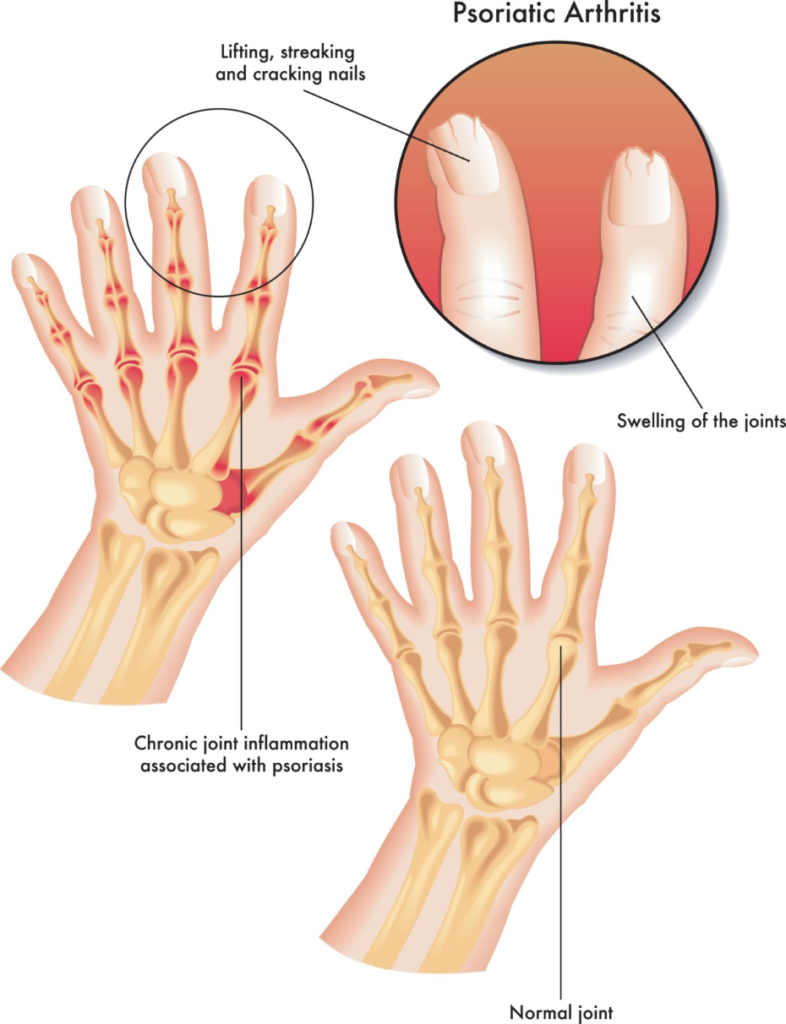
One of the most significant complications of psoriasis is psoriatic arthritis. This is a type of inflammatory arthritis that causes joints to become swollen, stiff, and painful. According to the NHS, around one in four people with skin psoriasis will go on to develop psoriatic arthritis. It can affect any joint in the body, including the hands, feet, knees, and spine. While the skin symptoms usually appear first, some people experience joint pain before they notice any skin plaques. If left untreated, psoriatic arthritis can lead to permanent joint damage, which is why early diagnosis and management are essential.
Does eczema affect the joints?
Unlike psoriasis, atopic eczema does not directly cause inflammation within the joints. There is no such condition as eczematous arthritis. However, the location of eczema flare-ups, often in the creases of the elbows and the backs of the knees, can make joint movement uncomfortable during a flare-up. If the skin is very dry or cracked over a joint, it may feel stiff or painful to move, but this is a result of the skin condition itself rather than an underlying problem with the joint structure.
Can eczema affect the nails?
While eczema is not a nail disease in the same way psoriasis is, severe or chronic eczema on the hands and fingers can lead to nail changes. If the skin around the base of the nail (the cuticle and nail fold) becomes chronically inflamed, it can disrupt the growth of the nail. This may result in horizontal ridges across the nail, known as Beau’s lines, or a general coarsening of the nail texture. However, the characteristic deep pitting and oil drop spots seen in psoriasis are typically absent in eczema patients.
How do these conditions affect the rest of the body?
Eczema and psoriasis are often part of wider health patterns. Atopic eczema is frequently associated with the atopic march, where a patient may also suffer from asthma, hay fever, or food allergies. This is due to a generalised oversensitivity of the immune system to environmental triggers. Psoriasis is increasingly recognised as a systemic condition that can be associated with an increased risk of other inflammatory issues, such as cardiovascular disease and metabolic syndrome. This is why NICE clinical guidance emphasises the importance of monitoring the overall health of patients with moderate to severe psoriasis.
| Feature | Atopic Eczema | Psoriasis |
| Nail Involvement | Possible (secondary to skin inflammation) | Common (pitting, thickening, lifting) |
| Joint Involvement | None (skin stiffness only) | Common (psoriatic arthritis) |
| Systemic Links | Asthma, Hay fever, Allergies | Psoriatic arthritis, Cardiovascular health |
| Primary Location | Skin creases (elbows, knees) | Extensor surfaces (elbows, knees), Scalp |
When should you seek help for nail or joint changes?
If you have a diagnosis of psoriasis and begin to notice persistent joint pain, morning stiffness, or swollen fingers that look like sausages (dactylitis), you should consult a healthcare professional. These can be early signs of psoriatic arthritis. Similarly, if your nails are becoming painful or preventing you from performing daily tasks, a GP can offer treatments or refer you to a dermatologist. Early intervention is particularly important for joint symptoms to prevent long term mobility issues and ensure the correct systemic treatments are started.
Conclusion
While eczema is largely confined to the skin and its associated allergic pathways, psoriasis is a systemic condition that frequently affects the nails and joints. Understanding these differences is vital for patients to monitor their health effectively. While eczema may affect the appearance of nails through surrounding skin inflammation, it does not carry the same risk of inflammatory joint disease that is associated with psoriasis.
If you experience sudden, severe joint pain accompanied by a high fever and a feeling of being very unwell, call 999 immediately.
Can psoriatic arthritis be cured?
There is no cure for psoriatic arthritis, but there are many effective treatments available in the UK that can manage symptoms and prevent joint damage.
Is nail psoriasis the same as a fungal nail infection?
No, they are different conditions. While they can look similar, nail psoriasis is caused by the immune system, whereas a fungal infection is caused by a pathogen.
Why does my eczema make my joints feel stiff?
The stiffness is usually caused by the skin over the joint being very dry, thickened, or inflamed, rather than the joint itself being affected.
Can children get psoriatic arthritis?
Yes, though it is much rarer in children than in adults. It is a form of juvenile idiopathic arthritis.
Will my nail psoriasis go away if my skin clears up?
Not always; nail psoriasis can be more persistent than skin plaques and may require specific treatments like steroid injections or systemic medicine.
Do all people with psoriasis get joint pain?
No, only about 20% to 30% of people with psoriasis develop psoriatic arthritis.
Can asthma treatments help my eczema?
While they are related, asthma medications like inhalers do not treat skin eczema, though managing your overall allergies can sometimes help skin stability.
Authority Snapshot (E-E-A-T Block)
This article clarifies how eczema and psoriasis can impact the body beyond the skin, focusing on nails and joints. It is written by the MyPatientAdvice Medical Writing/Research Team and reviewed by Dr. Rebecca Fernandez, a UK-trained physician with experience in internal medicine and surgery. All content is based on NHS and NICE clinical standards to ensure accurate information for patient safety and education.



